


Introduction to Socratic Shared Structure
Simply reading Plato’s Socratic dialogues is rarely enough to develop the ability to think and question as Socrates does. We can admire the skill, follow the arguments, and even feel the force of the aporia, yet still struggle to apply the same rigor to our own claims or to the claims of others. The missing piece is a practical framework that makes the underlying moves of Socratic questioning visible, analyzable, and transferable.
The Categories of Legitimate Reservation (CLRs), drawn from the Theory of Constraints Logical Thinking Process, supply exactly that framework. Originally developed as a set of disciplined checks for testing the logical soundness of cause-and-effect statements, the CLRs turn out to map remarkably well onto the patterns of questioning we find throughout the early Platonic dialogues. By systematically asking whether a claim is clear, whether the entities it posits actually exist, whether the claimed causal links hold, and whether the reasoning suffers from insufficiency, missing causes, reversal, failed predictions, or circularity, we gain a structured way to both understand Socrates’ method and practice it ourselves.
This approach does not claim that Socrates consciously used the CLRs. Rather, it treats the dialogues as a rich historical laboratory of rigorous questioning and the CLRs as a modern analytical lens that reveals the recurring logical operations at work. The result is a method—or at least a reliable checklist—that helps learners move from passive appreciation to active capability.
The process is straightforward. A learner selects a passage, identifies the interlocutor’s claim, and then examines Socrates’ responses through the progressive levels of the CLRs:
- Level I focuses on Clarity—ensuring terms and relationships are unambiguous.
- Level II tests Entity Existence and Causality Existence.
- Level III probes deeper issues of sufficiency, additional causes, reversals, predicted effects, and tautology.
Working through these levels turns each dialogue into deliberate practice. Over time, the same sequence can be applied to contemporary arguments, workplace discussions, or personal beliefs, building a durable habit of precise, constructive critical thinking.
The goal is not to reduce living dialectic to a mechanical formula, but to make its logical core explicit so that it can be learned, refined, and used. In doing so, we honor both the spirit of Socratic inquiry and the practical power of structured logical scrutiny.
Recalling the Eight Categories
Category |
Purpose |
|---|---|
| 1. Clarity | Ensures complete understanding of terms and relationships, avoiding ambiguity. |
| 2. Entity Existence | Confirms that the entities involved actually exist within the scope of analysis. |
| 3. Causality Existence | Validates whether a cause truly leads to the stated effect. |
| 4. Cause Sufficiency | Checks if the identified cause is sufficient on its own to produce the effect. |
| 5. Additional Cause | Investigates whether there are other causes that could also lead to the same effect. |
| 6. Cause-Effect Reversal | Addresses potential confusion between cause and effect. |
| 7. Predicted Effect Existence | Looks for additional expected effects that validate the existence of the cause. |
| 8. Tautology | Identifies circular reasoning where the cause is only supported by the effect itself. |
Integratin the CLRs into the Socratic Approach emphasizes dialogue and questioning, which fosters critical thinking by encouraging individuals to examine their beliefs and assumptions deeply. This method promotes a mindset of inquiry, allowing for the exploration of multiple perspectives and the development of well-reasoned arguments in modern philosophical discourse.
For example, someone says, “Long approval times cause missed deadlines.” A Socratic discussion would ask what counts as “long,” whether approvals really precede the missed deadlines, whether they delay critical work, and whether other causes—such as late project inputs—could explain the same outcome. The CLRs make those questions systematic, helping the group improve the logic without treating the first explanation as proven.
CLRs can be described as a practical framework for applying Socratic questioning to cause-and-effect reasoning in business, especially in TOC’s Logical Thinking Process. They don’t define the whole Socratic approach; rather, they give people disciplined questions for testing assumptions, evidence, and causal claims.
In business, the Categories of Legitimate Reservations provide a structured way to practice Socratic inquiry. By questioning the clarity, evidence, and causal logic behind claims, teams can test assumptions and develop more reliable cause-and-effect reasoning.
The Categories of Legitimate Reservations provide a structured way to apply Socratic inquiry across business reasoning—including problem analysis, planning, and continuous improvement—by testing the clarity, evidence, and cause-and-effect logic of claims and proposed actions.
CLRs don’t prevent disagreement, but they can make questioning feel less personal and more constructive.
With CLRs, the focus shifts to the reasoning: Is this statement clear? What evidence supports this link? Could another cause explain the outcome? That, again, gives the group common criteria for examining claims, rather than leaving the questioning to seem arbitrary or adversarial.
So, let's be clear, the CLRs are not simply Socratic questioning under another name, nor can we establish that Socrates used this formal checklist. But they can be understood as a later, structured framework that shares important features with Socratic inquiry: clarifying claims, testing assumptions, and examining whether conclusions follow from their premises.
Examples:
When people encounter Socratic inquiry as an abstract ideal, it can be difficult to understand and apply. Introducing the CLRs gives that inquiry a practical structure: learners can see what questions to ask and what each question tests. This can make the Socratic approach more accessible, helping people move from understanding it conceptually to using it in practice.
Across the Platonic dialogues examined, one can identify instances resembling each of the eight CLRs. This suggests a strong affinity between Socratic questioning as portrayed by Plato and the kinds of reservations later formalized in the Logical Thinking Process—but does not establish direct historical derivation.
1. From Euthyphro (seeking a definition of piety/holiness)
Sample exchange (condensed):
Euthyphro: Piety is doing what I am doing now—prosecuting the wrongdoer (even if it is my father).
Socrates: That is an example of a pious action, but I asked for the form or essence itself—the one thing that makes all pious actions pious. Can you give me that standard so I can measure any action against it?
(Later) Euthyphro: Piety is what is dear to (loved by) the gods.
Socrates: The gods quarrel and disagree among themselves. Therefore the same action could be both dear to some gods and hateful to others—both pious and impious at once. That cannot be right. Is the pious loved by the gods because it is pious, or is it pious because it is loved by the gods?
Plausible CLRs:
- Clarity (primary): Socrates refuses the example and demands an unambiguous, general account of the term.
- Entity Existence / Causality Existence: Does the proposed entity (“what the gods love”) actually exist as a consistent, usable standard? Does the claimed causal link (gods’ love → piety) hold without contradiction?
- Cause Insufficiency / Predicted Effect Existence: The definition fails to produce consistent predicted effects (a single action cannot be both pious and impious).
This is classic Level-I and Level-II scrutiny applied to a definitional claim. You can download the full dialogues HERE!
2. From Laches (seeking a definition of courage)
Sample exchange (condensed):
Laches: Courage is standing firm at one’s post and not running away in battle.
Socrates: That covers soldiers in the ranks, but what about cavalry, sailors facing storms, people enduring disease or poverty, or those who fight against desires and pleasures? I want the single quality common to all these cases.
(Later) Laches: Courage is a certain endurance of the soul.
Socrates: Is all endurance courage? Courage is something fine and noble. Yet foolish endurance (enduring in a stupid or harmful cause) is base and harmful. So endurance alone is insufficient; it must be wise endurance. But then we run into further difficulties about what kind of wisdom...
Plausible CLRs:
- Clarity: The initial answer is too narrow/ambiguous; intermediate cases and the full scope are missing.
- Cause Insufficiency: Standing firm or mere endurance is not sufficient by itself to produce the effect “courage.”
- Additional Cause / Predicted Effect Existence: Other independent factors (wisdom, context) must be present; counter-examples show the predicted effect does not always follow.
Socrates systematically tests sufficiency and looks for missing conditions. You can download the full dialogues HERE!
3. From Meno (seeking a definition of virtue)
Sample exchange (condensed):
Meno: There is the virtue of a man (manage the city, benefit friends, harm enemies), the virtue of a woman (manage the household and obey her husband), the virtue of a child, a slave, etc.—many different virtues.
Socrates: Even if they are many and various, they all have some one common character that makes them virtues. Tell me that single form, not a swarm of them.
(Later) Meno: Virtue is the power of governing / ruling over people.
Socrates: Does this apply to a child or a slave? Can a slave rightly rule his master? If not, the definition does not cover all cases of virtue.
Plausible CLRs:
- Clarity: Multiple particular answers are offered instead of a clear, unified account.
- Entity Existence: Does a single “virtue” entity exist that is common to all the listed cases?
- Cause Insufficiency / Additional Cause: “Power to rule” does not suffice for every instance and leaves out necessary conditions (justice, appropriateness to the person, etc.).
The dialogue repeatedly forces the interlocutor to move from lists of examples to a testable general claim. You can download the full dialogues HERE!
4. From Republic Book I (Thrasymachus on justice)
Sample exchange (condensed):
Thrasymachus: Justice is nothing else than the advantage of the stronger. Rulers make laws to their own advantage, and that is what is called just.
Socrates: Do rulers sometimes make mistakes about what is truly to their advantage? If so, then obeying those mistaken laws would be both just (according to your definition) and not advantageous to the stronger—contradiction. Moreover, every genuine craft (medicine, navigation, etc.) aims at the good of the subject it rules, not the ruler’s private advantage. Therefore true ruling (and true justice) aims at the advantage of the weaker, not the stronger.
Plausible CLRs:
- Causality Existence: Does “advantage of the stronger” actually cause or constitute justice?
- Cause-Effect Reversal / Predicted Effect Existence: The claimed direction of the causal arrow is tested and reversed by analogy with other crafts; predicted effects (consistency under error, benefit to the ruled) fail to appear.
- Entity Existence: Does “the stronger” (in the precise sense of a true ruler) even exist in the way claimed?
This is a higher-stakes application of Level-II and Level-III reservations against a bold causal claim. You can download the full dialogues HERE!
Across the dialogues, Socrates almost always begins with a Clarity reservation (“What exactly do you mean?” / “Give me the form, not an example”). He then tests Entity Existence and Causality Existence. When those pass or fail, he moves to sufficiency, additional causes, predicted effects, reversals, and circularity. The pattern is remarkably consistent with the progressive levels of the CLRs, even though the medium is spoken dialectic rather than written logic trees.
These samples do not prove that the CLRs were derived from Plato, but they show that a modern reader who knows the CLR framework can readily map the moves of Socratic questioning onto it. The underlying cognitive operations—demanding clear terms, verifying that the claimed entity and causal link exist, checking sufficiency, hunting for counter-examples and missing conditions—are the same.
Strengths of the TLSBlue Approach
- It operationalizes the method. The CLRs already form a progressive checklist (Clarity → Existence → Causality → Sufficiency/Additional/Reversal/Predicted Effects/Tautology). Using them as a lens on each Socratic exchange gives students (or yourself) concrete questions to ask: “Which reservation is Socrates raising here? Why does this particular one fit? What would a different reservation look like in the same spot?”
- It bridges ancient and modern rigorous thinking. The dialogues supply rich, human, high-stakes examples; the CLRs supply a clean, non-jargon-heavy structure that people can apply to everyday arguments, business logic trees, policy claims, or their own reasoning. This dual exposure is more powerful than either tool alone.
- It supports deliberate practice. A checklist or simple method derived from this can be used for:
- Annotation exercises (mark each exchange with the dominant CLR(s)).
- Role-play / reconstruction (given a claim, generate the Socratic-style questions that correspond to successive CLRs).
- Transfer tasks (take a modern claim and apply the same sequence).
- It respects the spirit of both systems. Socrates aims at clarity and the exposure of inconsistency; the CLRs exist precisely to raise legitimate reservations without unnecessary confrontation. This framing keeps the constructive, truth-seeking character of both.
Potential limitations and how to address them
- Not every move is a pure CLR. Some Socratic questioning is protreptic (motivational), ironic, or aimed at producing aporia for its own sake. A rigid checklist might over-force the mapping. Solution: treat the CLRs as the primary analytical tool while allowing a residual category (“other dialectical purpose”) and note when multiple CLRs operate simultaneously.
- Order is flexible in the dialogues. Socrates does not always march strictly Level I → II → III. The method/checklist should emphasize the logical priority of Clarity first (as TOC does) while noting that skilled practitioners jump around once clarity is secured.
- Risk of reducing living dialogue to mechanical steps. The best safeguard is to keep the original dramatic context visible and to practice generating questions, not just labeling them.
- Depth vs. accessibility. A full eight-item checklist is powerful for advanced users; a simplified three-level version (Clarity / Existence & Causality / Deeper causal scrutiny) may be better for initial learning.
Disclaimer
This is a high-value purpose. It has clear educational merit, intellectual honesty (we are not claiming Socrates “used CLRs,” only that the categories help us understand and internalize his questioning), and a concrete output goal (a method or checklist). It is more likely to produce transferable critical-thinking skill than either reading the dialogues alone or learning the CLRs in the abstract.
Socratic Approach + CLRs ⇒ A powerful way to practice disciplined inquiry.
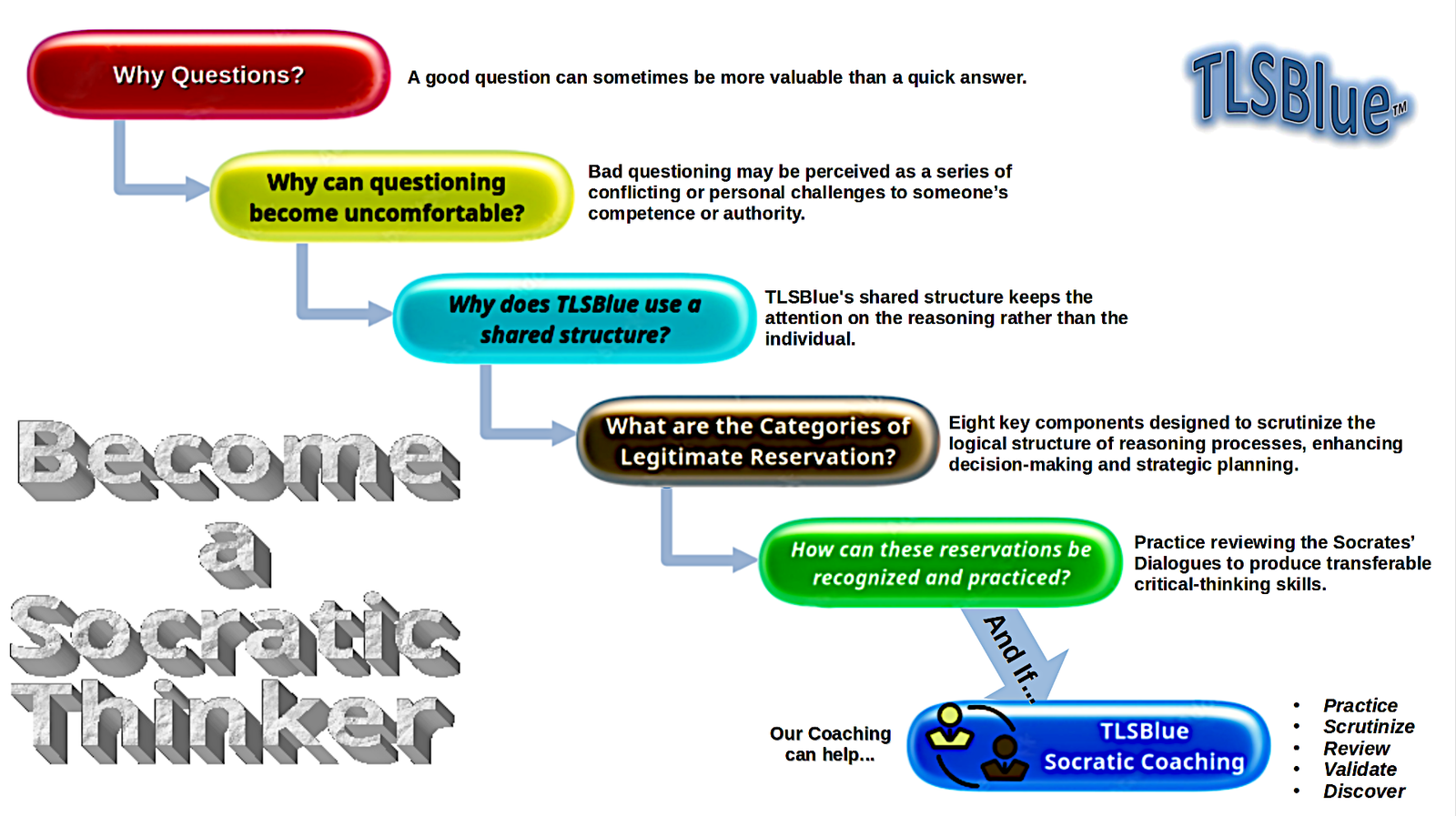
Click & View how to become a Socratic Thinker
Socratic Approach: Learn Through Questioning
The Socratic approach to critical thinking is associated with Socrates, the Greek philosopher who lived from 470 to 399 BC. Through probing questions, Socrates challenged assumptions, exposed contradictions and encouraged deeper examination of ideas.
So, what if learning does not begin with being given the answer?
- The Socratic approach begins with questions.
- Questions help us examine what we believe, uncover assumptions, connect ideas and discover what we may have overlooked. Rather than telling you what to think,
- Socratic approach to learning helps you develop the questioning needed to reach your own better understanding.
And perhaps: A good question can sometimes be more valuable than a quick answer.
The Socratic approach to critical thinking is sound because it encourages active engagement through questioning, allowing individuals to explore their beliefs and assumptions deeply. This method promotes a better understanding of complex topics by revealing contradictions and fostering independent reasoning. In contrast, other critical thinking methods may focus more on structured analysis or logical reasoning without the same level of interactive questioning and discussion.
The Socratic method enhances critical thinking skills in businesses by encouraging paticipants to question their assumptions and explore different perspectives, leading to a deeper understanding of complex ideas. It also fosters active participation and engagement in the learning process, making it more interactive and stimulating.
For example, someone says, “Long approval times cause missed deadlines.” A Socratic discussion would ask what counts as “long,” whether approvals really precede the missed deadlines, whether they delay critical work, and whether other causes—such as late project inputs—could explain the same outcome.
But, one must be careful because Socratic questions may be perceived as a series of conflicting or personal challenges to someone’s competence or authority. So, it is appropriate to have a shared structure or shared framework to help make inquiry systematic and focused on the validity of the reasoning, rather than on the person presenting it.
Recall that Socrates' trial occurred in 399 B.C. during a tumultuous period in Athens, following the Peloponnesian War. His methods of questioning and debate often embarrassed prominent citizens, leading to widespread animosity towards him. Additionally, his criticism of democracy and association with controversial figures made him a target for those who felt threatened by his influence—Socratic inquiry can become personally confrontational if people perceive questioning as an attack.
TLSBlue's shared structure keeps the attention on the reasoning rather than the individual, because Socratic inquiry works best when questioning is directed toward the reasoning rather than the person.
TLSBlue therefore uses a shared structure to make inquiry systematic, constructive and focused on examining claims, assumptions and cause-and-effect reasoning, and The Categories of Legitimate Reservation provide one such structure.